

With support from the European Union and funding from the federal government’s special fund for infrastructure and climate neutrality, the state of Mecklenburg-Western Pomerania is investing over 50 million euros in this construction project, with the aim of bringing it into operation in August 2028.
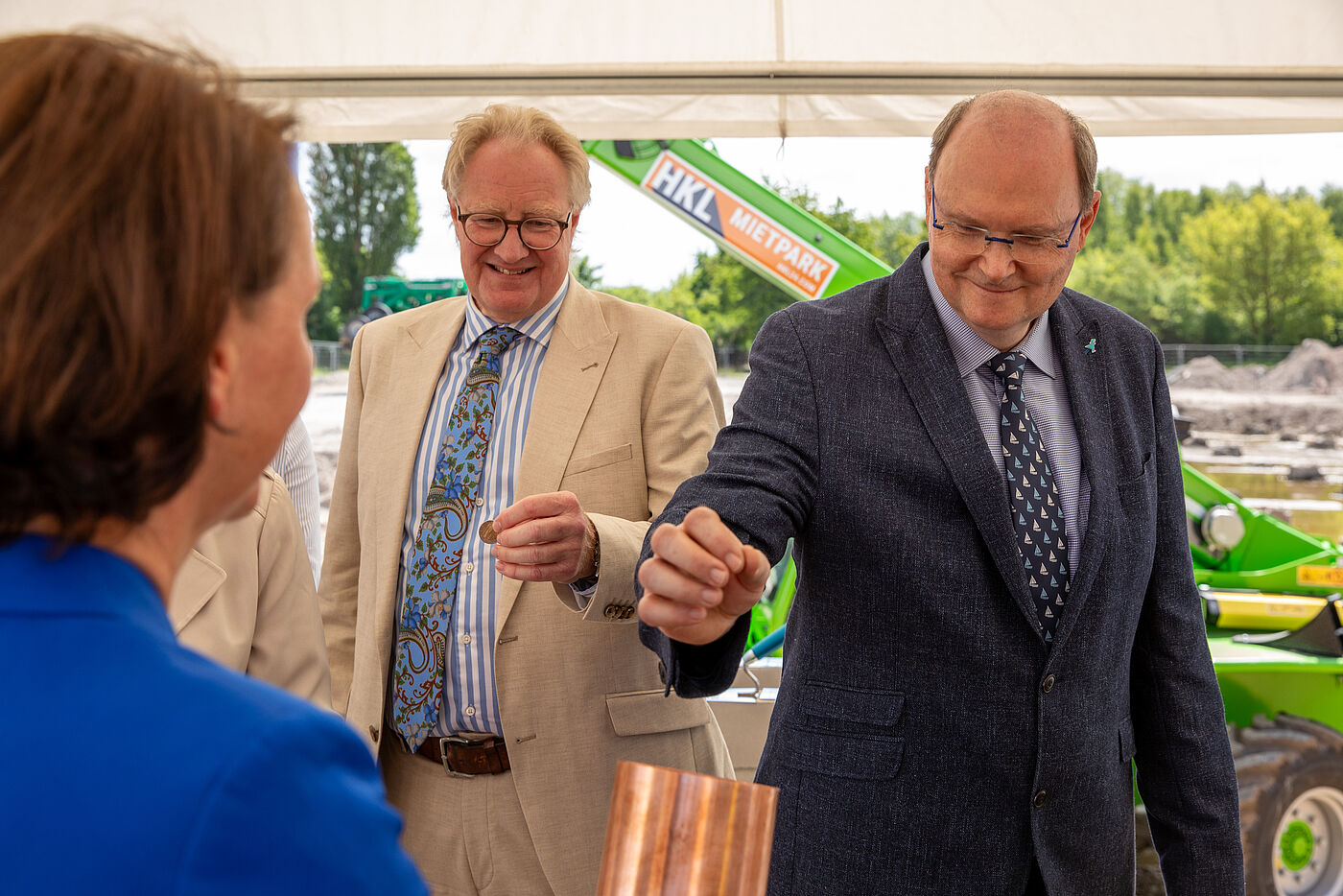
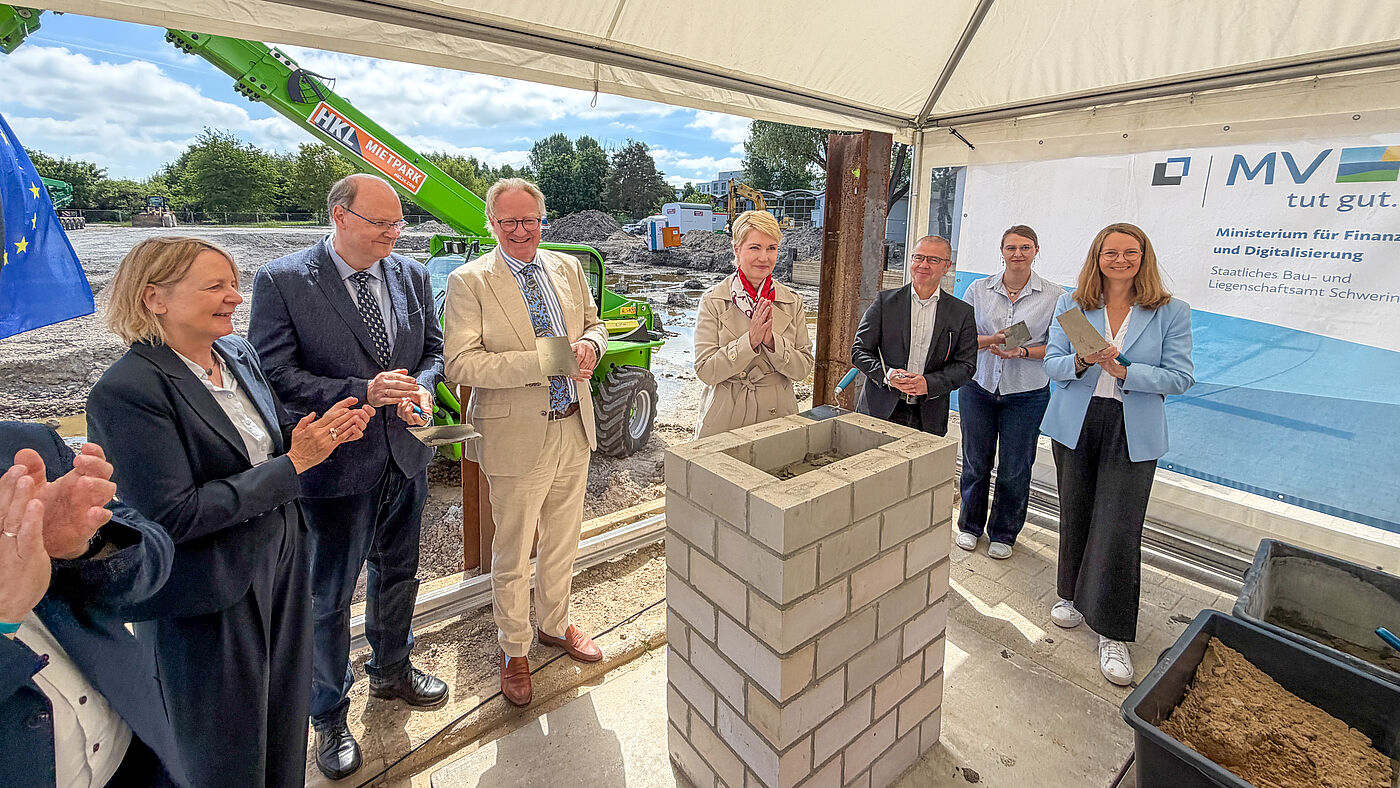
Those involved in the laying of the traditional foundation stone included
the Minister-President of Mecklenburg-Western Pomerania, Manuela Schwesig,
the Head of the State Building and Property Administration in Mecklenburg-Western Pomerania, Schwerin (SBL), Dr Andreas Werner,
the Minister for Science of Mecklenburg-Western Pomerania, Bettina Martin
the State Secretary at the Ministry of Finance and Digitalisation, Dr Carola Voss,
and the Rector of Wismar University of Applied Sciences, Prof. Dr jur. Bodo Wiegand-Hoffmeister
as well as the representative of the MVU division, Prof. Dr.-Ing. Martin Krohn.
They had just signed a certificate: “With best wishes for the success of the construction project for the benefit of the state of Mecklenburg-Western Pomerania”
In their opening remarks, the Head of the SBL, the Minister-President and the Rector all addressed the current context of university construction as well as future Wismar UAS development, and described the laying of the foundation stone as a positive sign of close and fruitful cooperation.
The laboratory building, to be known as Building 14, will be the second new building for the Faculty of Engineering on the Wismar campus, following Building 6, which houses the Civil Engineering department. It is intended to replace the mechanical engineering laboratories and seminar rooms currently located in various places, such as the laboratory complex on Baumweg, and in different buildings.
Directly adjacent to the Faculty of Architecture and Design building, House 7 – which was handed over as a new building 26 years ago – a large hall will be constructed, with a three-storey office block situated in front of it. Thanks in part to the close collaboration between the future users and the planners, this complex will offer optimal conditions for innovative, practice-oriented teaching and for applied research across a wide range of disciplines. To this end, the entire structure, with its state-of-the-art building services, will itself be used as a teaching aid, demonstration and test facility.
Particular emphasis is placed on the energy-efficient and sustainable design of the 40-by-85-metre building. Compliance with the requirements of energy-optimised and sustainable construction is a key priority. The use of a photovoltaic system and geothermal energy makes a significant contribution to achieving climate protection targets. Together with the consistent implementation of sustainable construction, the building has thus achieved silver certification under the ‘Sustainable Building’ (BNB) assessment system.