
As modern onshore and offshore wind turbines continue to grow in size, the SCHMIDT/NEUPER method for fatigue analysis of ring flange connections is increasingly reaching the limits of its applicability when it comes to safely dimensioning the bolts. With the development of powerful FE models, analyses are increasingly being performed for various flange configurations, taking into account characteristic flange gap imperfections that contribute to the normal and bending stresses acting in the preloaded bolted joint. If the prevailing normal and bending stresses are fully accounted for on the load side during fatigue verification of the bolt’s fatigue strength under pure tension, current findings reveal safety margins that have not been utilized in fatigue verification to date.
Verification based on the normal forces acting in eccentrically loaded bolted joints against a detail category that includes bending effects on the load-bearing side cannot be performed in general, or can only be performed within certain limits. In addition to classic constructional details, such as bolts, circular, longitudinal, and fillet welds for fastening components to so-called welded sockets, there are other constructional details that cannot be designed according to existing codes, or can only be designed very conservatively. These are ring flanges made of structural steel (S355N), which are typically normalized after manufacture. For the flange radius, existing regulations do not require a fatigue strength verification, provided geometric boundary conditions are met. Here, too, the increasing size of modern wind turbines is having an impact, so that verification is increasingly being required for this constructional detail as well, and cannot be provided—or can only be provided very conservatively—using the current state of the art.
The research project aims to investigate the fatigue behavior of the two constructional details (eccentrically loaded bolted joint and flange radius). Furthermore, a comprehensive characterization of the materials used will be conducted. Based on these investigations, a design approach for the constructional details is to be developed as an enhancement of the existing standards (Eurocode 3, IEC 61400-6).
Optimized design of cyclically loaded ring flange connections in wind turbine support structures, taking sustainability considerations into account
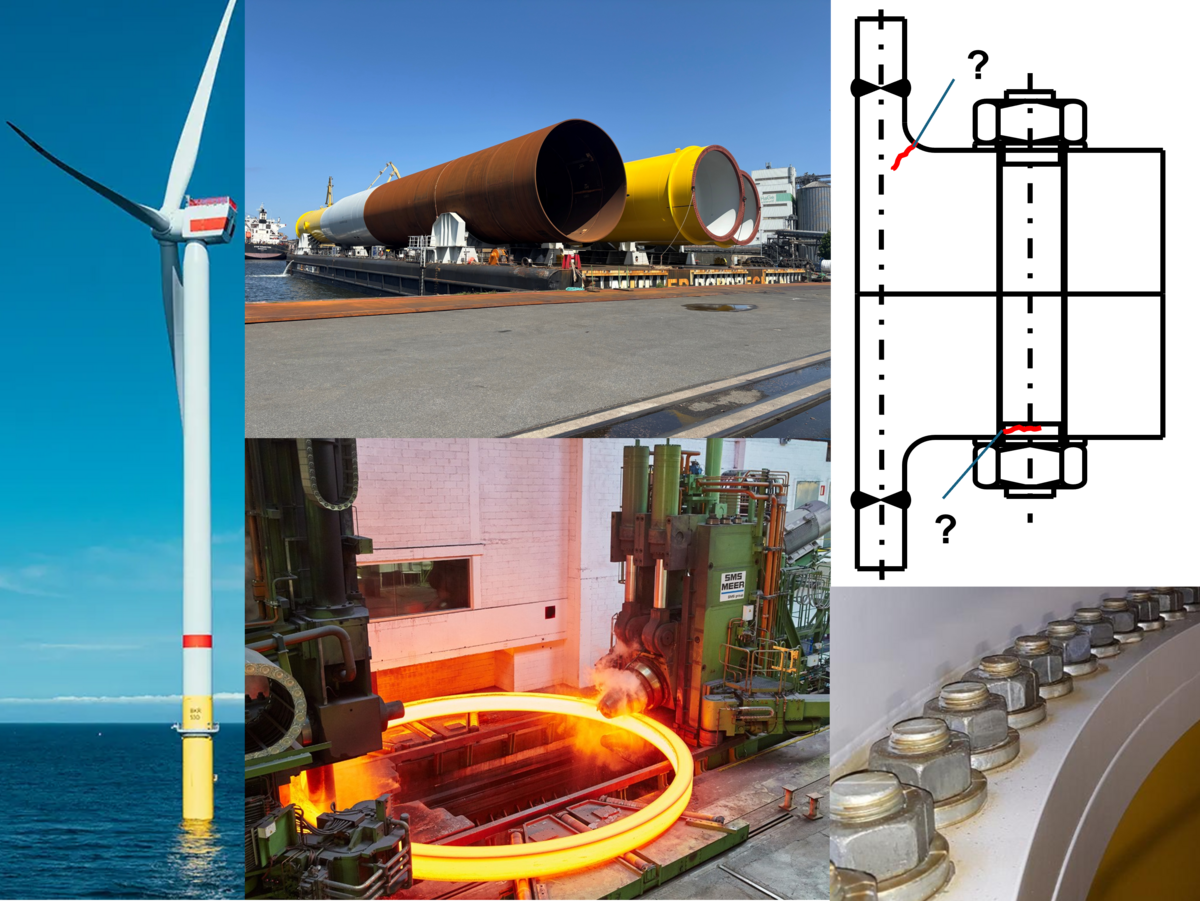
Sources from left to right: orsted.de/offshore-windenergie/unsere-offshore-windparks-nordsee, eew-group.com/de/projekte-referenzen/erfolgsmeldungen/news-detail/all-monopiles-for-sofia-shipped/, euskalforging.com/en/news/200-euskalforging-breaks-world-record-supplying-10-000mm-80t-input-weight-ring-world-s-most-powerful-quiet-hammer, Gregor Steglich, Hochschule Wismar, J.B.O
back to the overview