

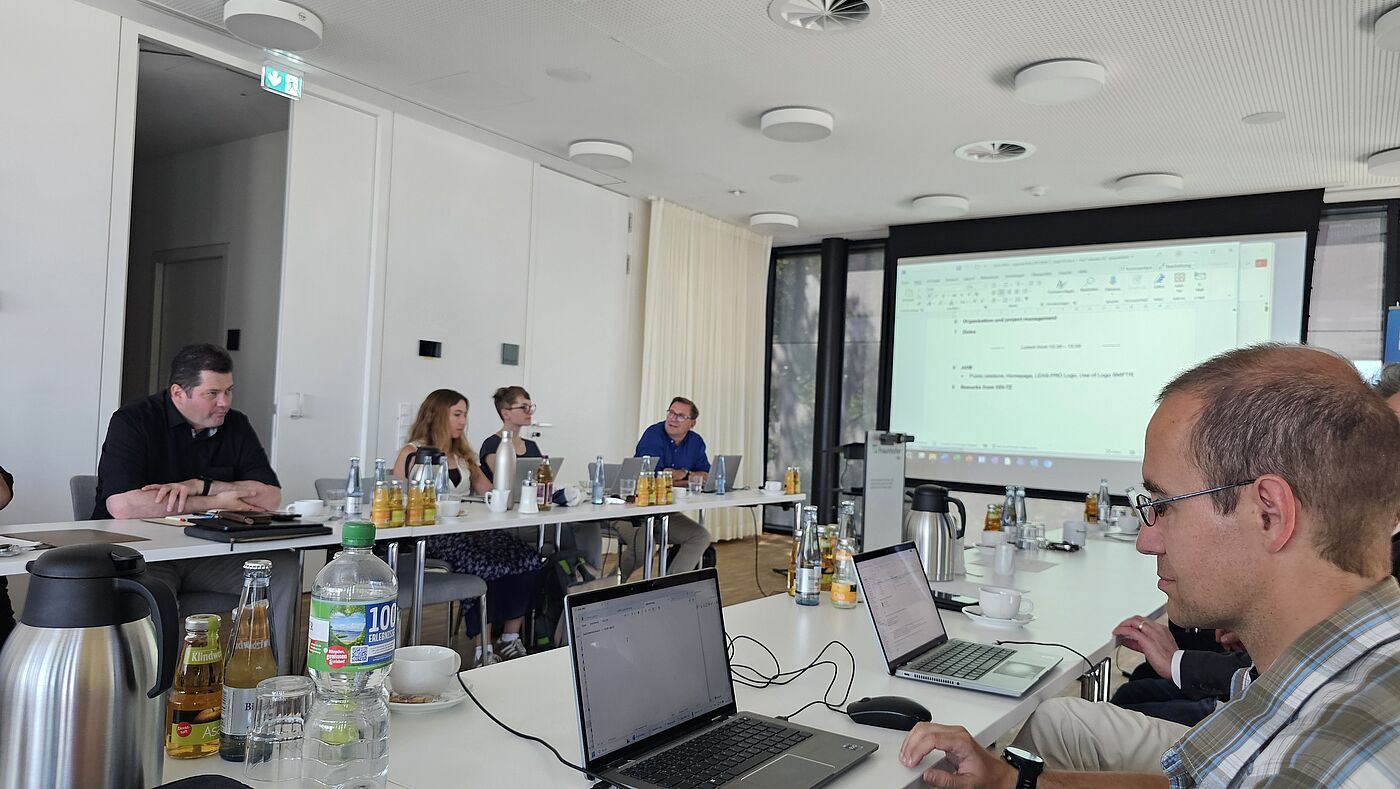
The BMFTR R&D project ‘LEAS-Pro’ has been launched with the participation of our UAS. The project aims at ensuring the safety of future maritime transport.
The research project ‘Shore-based Decision Support for Traffic Situations Involving Highly Automated and Autonomous Ships – Pro’ (LEAS-Pro) was officially launched with a two-day kick-off meeting held at the Fraunhofer Centre for Maritime Logistics and Services in Hamburg-Harburg on 14–15 July 2026.
The aim of the overall project is to develop and implement suitable methods and procedures for shore-based traffic monitoring to ensure the safety and smooth flow of mixed maritime traffic. This is because future maritime transport will no longer consist solely of conventionally controlled and highly automated ships. Soon, it will also be characterised by remotely controlled and autonomously navigating vessels. This will give rise to new tasks not only on board, but also on parties involved from shore-side.
The joint project, funded by the Federal Ministry of Research, Technology and Space (BMFTR) under the funding call ‘Making Comprehensive Use of Innovations – Practical Beacons of Civil Security’, will be carried out over the next two years by a national consortium led by the Fraunhofer Institute for Communication, Information Processing and Ergonomics in Bonn-Wachtberg.
The collaborative project, funded by the Federal Ministry of Research, Technology and Space (BMFTR) under the call for proposals “Innovationen umfassend nutzen – Praxisleuchttürme der zivilen Sicherheit” ‘Making Comprehensive Use of Innovations – Practical Beacons of Civil Security’ with total funding of around 3.5 million euros will be carried out over the next two years by a national consortium led by the Fraunhofer Institute for Communication, Information Processing and Ergonomics in Bonn-Wachtberg. Together, the consortium aims to further develop the results from the predecessor project LEAS and bring them closer to practical application.
This will be ensured by the industrial partners involved in the project (in-innovative navigation GmbH, JDS GmbH and Bergmann Marine GmbH) as well as national and international users acting as associated project partners. In addition to the institutions already mentioned, the project team is completed by two research institutes of the German Aerospace Centre (DLR) – the Institute of Communication and Navigation and the Institute for the Protection of Maritime Infrastructure – as well as ISSIMS, an institute at Wismar University of Applied Sciences.
The Federal Ministry of Digital and Transport (BMDV), the Directorate-General for Waterways and Shipping (GDWS), the Baltic Sea Waterways and Shipping Authority, IBM Deutschland GmbH and Fintraffic are also actively involved in the project as associated partners.
The scope of the sub-project being carried out by Wismar University of Applied Sciences includes, amongst other things, simulation studies at the Maritime Simulation Centre in Warnemünde. The aim there is to simulate the operational integration of these innovative maritime transport modes. This includesfor instance, cooperation between operators at VTS traffic control centres and operators at the control centres for remotely operated vessels. The aim is, for example, to determine which operational and procedural measures can ensure a transition from shore-based maritime traffic safety systems that is as conflict-free as possible, whilst maintaining the current level of safety.