
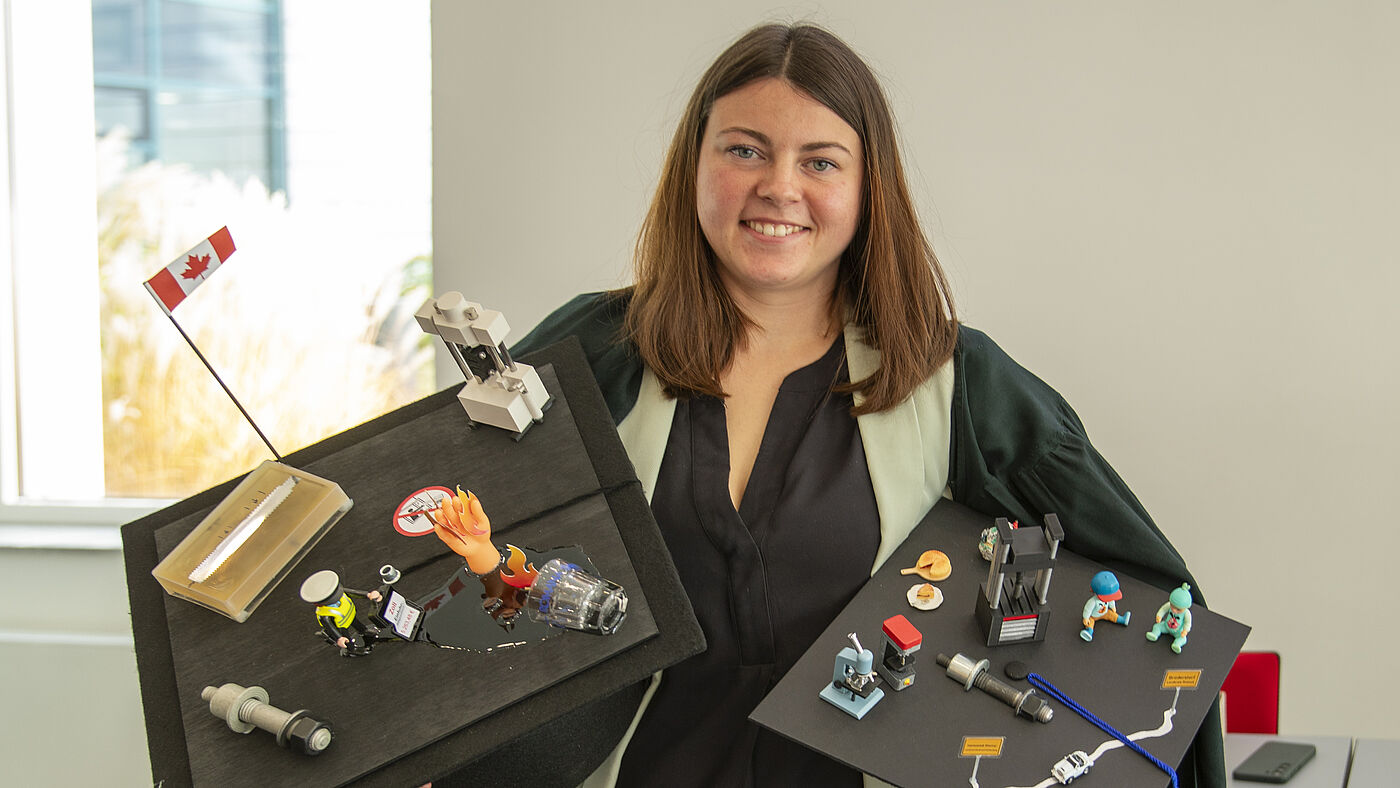

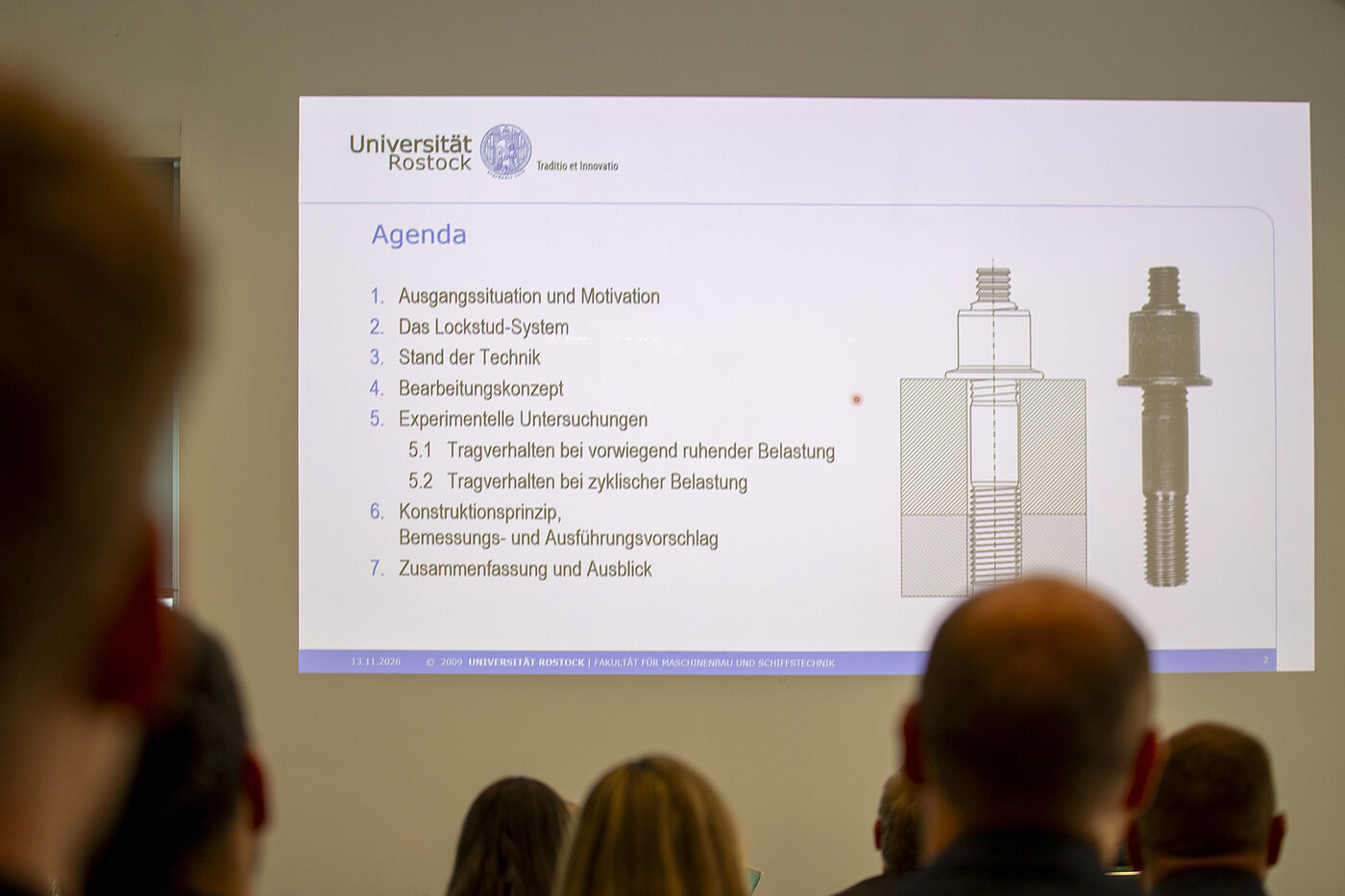
While Friday the 13th is often considered an unlucky day, it proved to be a day of celebration for Melanie Hagemann. On 13 November 2026, she successfully defended her doctoral thesis, entitled “Contribution to the Design and Execution of axially loaded, high-strength preloaded Connections using lockstud systems” at the Fraunhofer Institute for Large Structures in Production Engineering (IGP) in Rostock.
During her collaborative PhD programme, she was supervised by Prof. Dr.-Ing. habil. Knuth-Michael Henkel from the Chair of Joining Technology at the Faculty of Mechanical Engineering and Marine Technologies at the University of Rostock, and by Prof. Dr.-Ing. Ralf Glienke from the Department of Mechanical, Process and Environmental Engineering (MVU), Faculty of Engineering (FIW), at Wismar University of Applied Sciences.
In her doctoral thesis, the 32-year-old Melanie Hagemann investigated the assembly and load-bearing behaviour of Lockstud systems. This type of stud bolt has a standard metric thread for creating a threaded joint in a tapped hole, and a grooved section with a corresponding collar on the assembly side. The Lockstud system combines the advantages of a bolted joint with single-sided accessibility with those of lockbolt systems, such as the maintenance-free behaviour due to the locking effect. Lockstud systems offer considerable potential, particularly for modular construction and repair applications in sectors such as wind energy and rail vehicle manufacturing. However, their application has been limited by the lack of established design rules. In her doctoral thesis, Melanie Hagemann developed the first design principle for Lockstud systems and posed corresponding rules for design and execution.
Driven by her passion for technology, Melanie Hagemann, a qualified chemical laboratory technician, joined Wismar University of Applied Sciences in 2016 to pursue a Bachelor's degree in Mechanical Engineering, followed by a Master's degree in Mechanical Engineering, Process and Energy Technology. Immediately after completing her studies, she joined Wismar University of Applied Sciences as a research assistant in the Mechanics/Design research group, where she contributed to two IGF research projects. During this time, she also became a mother. Despite her new family responsibilities, she was able to successfully pursue her doctoral research.