
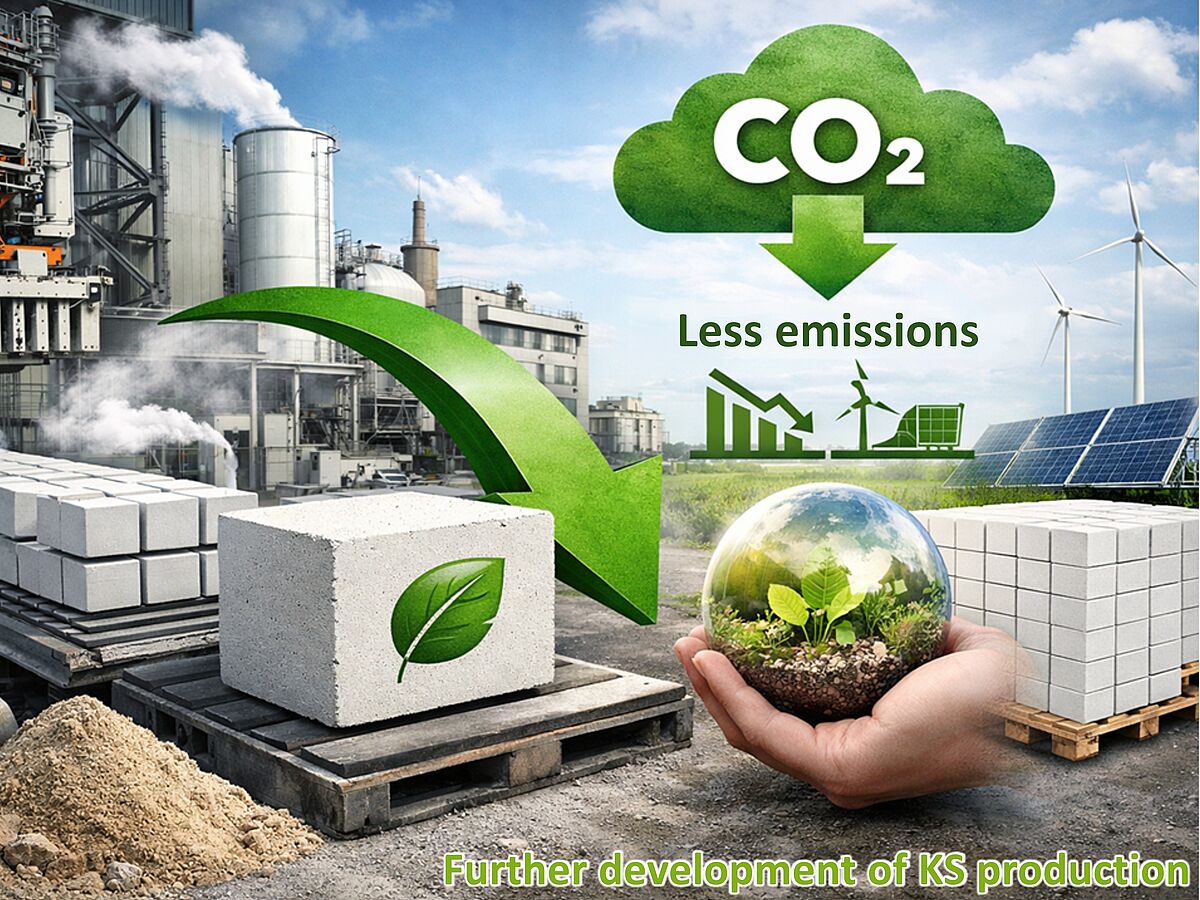
The sand-lime brick industry is facing the challenge of making its production climate-neutral by 2045 in line with the European Green Deal. The core problems are the high energy requirements of autoclaving, steam curing and CO₂ emissions during the production of quicklime. Currently, approx. 885,000 t CO₂/year, 80% of which comes from quicklime production. In the long term, however, one ton of sand-lime brick binds approx. 50 kg CO₂ through recarbonization.
The aim of the research project is to significantly reduce energy consumption and CO₂ emissions through optimized CSH-phases. Modern methods such as in-situ-XRD and Raman spectroscopy are intended to precisely analyze temporal phase formation for the first time. This is intended to find new, lower-energy autoclaving parameters without compromising product quality or recarbonization capability.
The roadmap 2045 shows that the industry is severely affected by rising energy and CO₂ costs. A reduction of the hardening temperature from 203 °C to 190...180 °C could reduce the energy consumption of a manufacturing plant by one GWh/a and thus also significantly reduce energy costs. At the same time, CO₂ emissions could be reduced by a double-digit percentage with adapted formulations.
The project is particularly relevant for SMEs, as they suffer greatly from energy and certificate costs. The project results are intended to strengthen competitiveness, price stability and standardization processes.
Scientifically, the project is based on the further development of the classic sandwich model by Mörtel (1978). Recent findings show a considerable optimization potential of the CSH-phases /calcium silicate hydrate phases, especially the strength-relevant Tobermorit. The planned investigations are intended to clarify how lime dose, raw materials, porosity and hardness parameters interact and how energy and CO₂ can be saved as a result.
The Research objectives include:
1. Proof of temperature reduction with the same quality
2. Reduction of the Quicklime dose
3. Ensuring recarbonization
4. Development of a practical forecasting model
5. Quantification of CO₂ savings potential
Decarbonisation of calcium bilicate brick production through the generation of CSH-binder-phases with a low carbon footprint – use of in-situ X-ray diffraction during autoclaving

back to the overview